



You start the morning with a clear plan. Then noon hits, your tabs multiply, your phone lights up, and your brain feels like a room with too many people talking at once.
That kind of focus loss rarely happens in one dramatic moment. More often, it gets chipped away by small habits, low-grade stress, and daily friction that seem harmless while they happen.
For people who care about energy, wellbeing, and getting through the day with a steadier mind, that matters. A scattered afternoon doesn’t always mean laziness. Sometimes it means your attention has been nicked a dozen times before lunch.
The digital noise that keeps your brain in shallow mode
Screens don’t just steal time. They also keep the mind hovering near the surface, never settling long enough to do deep, calm work. Recent 2026 reporting paints a stark picture: many workers face around 275 interruptions a day, and people now check their phones roughly 205 times daily. When that rhythm becomes normal, distraction starts to feel like the default.

Constant notifications train you to expect interruption
A ping from email, a text preview, a team chat bubble, a calendar nudge, each one feels tiny. Yet your brain still has to turn its head, even for a second.
That second is not the full cost. After the glance comes the reset, and that reset often takes longer than the check itself. As a result, you stay in partial attention, half on the task and half on what might pop up next.
After a while, the mind starts waiting for interruption. Silence feels strange, and sustained focus feels harder than it should.
Jumping between apps wears out your attention
Most people don’t lose focus because of one big distraction. They lose it through a hundred small jumps, from document to inbox, from spreadsheet to chat, from browser tab to phone.
Each switch asks your brain to reload context. That’s like stopping a car every block and expecting great fuel mileage. You still move, but the ride gets rough and wasteful.
Recent attention research has described screen focus windows that now average well under a minute. So even when you feel “on,” your attention may already be slipping into fragments.
Social media steals the small quiet moments your mind needs
Short breaks used to give the mind a little air. Now many people fill every pause with a quick scroll. Waiting for coffee, stuck on a sentence, bored for 20 seconds, the hand reaches for the phone.
That habit teaches the brain to avoid stillness. Hard tasks then feel even harder, because your mind expects a fast hit of novelty instead of a slow stretch of effort.
If every quiet moment gets filled, your brain never gets a true reset.
Over time, that creates restlessness. You sit down to work, but part of your brain still wants motion, color, and quick reward.
The work habits that look productive but ruin concentration
Not every focus problem comes from your phone. Some arrive dressed like responsibility. A packed day can look productive from the outside while your mind feels pulled apart inside.
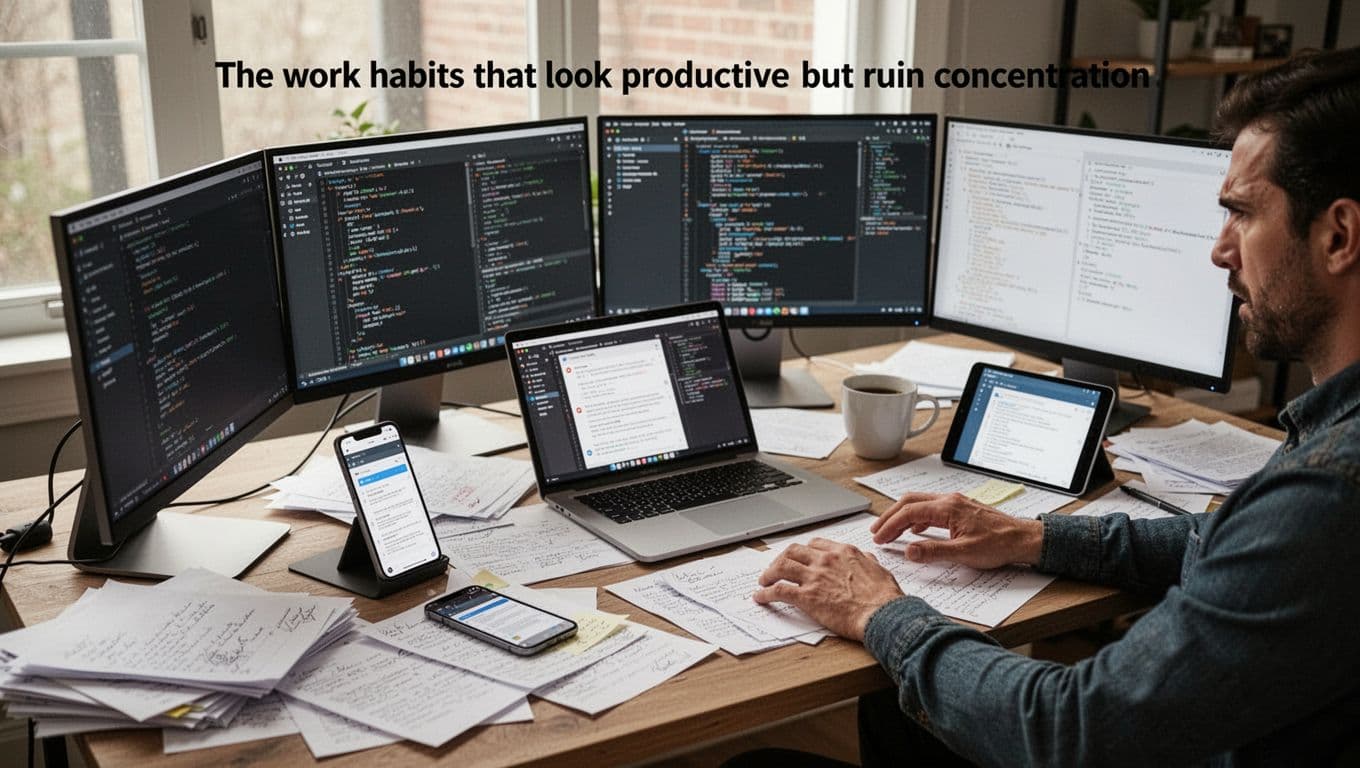
Multitasking feels efficient, but your brain pays for it
When you answer messages while writing, planning, or reading, it can feel efficient. In reality, you are usually switching fast, not thinking clearly in two places at once.
That speed hides the damage. Mistakes rise, details slip, and mental fatigue shows up sooner. By mid-afternoon, even simple decisions can feel strangely heavy.
This is why a busy day can still produce thin results. You worked the whole time, yet your best thinking never had room to land.
Too many priorities make every task feel urgent
A clear top task is like a bright trail through the woods. Too many priorities feel like standing at eight trailheads at once.
When everything is marked important, attention scatters. You start one thing, remember another, then jump again because a third item suddenly feels more urgent. Meanwhile, the original work stays half-done.
That constant sorting creates low-grade stress. You may look active, but inside, you’re stuck in indecision and the nagging feeling of never catching up.
Small interruptions from people and meetings break your rhythm
Not all interruptions come with a sound. Some arrive as quick check-ins, “got a minute” chats, surprise calls, or meetings that could have been a short note.
For thinking-heavy work, even a brief pause can knock you out of rhythm. The brain loses the thread, and returning to it feels like trying to pick up a dream after someone turned on the lights.
This isn’t about blaming coworkers, family, or friends. It’s about noticing that flow is fragile, and small breaks in attention often cost more than they seem.
The body signals that quietly chip away at focus
Focus is not just a mindset problem. It’s also physical. Your brain runs on sleep, steady energy, oxygen, movement, and a nervous system that isn’t stuck in strain.
When those basics wobble, attention gets dull. You can feel it in heavy eyes, foggy thinking, or that odd flatness that creeps in after lunch.

Poor sleep makes simple tasks feel harder than they should
A short night doesn’t always knock you out. Sometimes it leaves you awake but blurry, like trying to clean a window with a damp cloth.
Memory gets weaker, patience gets shorter, and your mind slips off the task more easily. Even routine work can feel oddly uphill. You are present, but not fully there.
That’s why tired people often blame themselves for being unfocused, when their brain is simply under-rested.
Sugar crashes and heavy meals can dull your mind
Food shapes attention more than many people think. Skip breakfast, grab a sugary snack, or eat a heavy lunch, and your energy can rise fast, then sink just as fast.
You know the feeling. At 11 a.m., you’re sharp. An hour after lunch, your eyelids feel heavier, and your thoughts move like wet sand.
This isn’t a call for strict eating. It’s a reminder that steady energy supports steady focus, and wild swings make concentration harder to hold.
Sitting too long can make your brain feel stuck too
Hours in one chair can leave your body tense and your mind flat. Shoulders tighten, breathing gets shallow, and your thoughts start to feel slow.
A small dose of movement often helps more than people expect. Stand up, stretch, walk to the end of the block, or do a few light mobility moves. Then the brain often feels less jammed.
Sometimes focus doesn’t need more effort. It needs fresh blood flow, a longer exhale, and a break from being folded over a desk.
The emotional and physical stressors most people overlook
Some of the strongest focus drains are the quietest ones. They sit in the background all day, draining attention the way a small leak drains a water bottle.
Low-level stress drains mental energy all day long
This isn’t only about panic or crisis. It’s the steady hum of worry, burnout, tension, money pressure, health concerns, or feeling stretched too thin.
That kind of stress keeps part of your brain scanning for trouble. As a result, it becomes harder to stay with one task, harder to settle, and easier to snap or shut down. Poor sleep, low drive, and irritability often travel with it, which only weakens focus more.
When your nervous system never quite settles, concentration becomes a lot more expensive.
A noisy, cluttered space keeps pulling your attention away
Your workspace talks to your brain, even when you think you’re ignoring it. Piles of clutter, loud background noise, bad lighting, a stiff chair, or a room that’s too hot can all tug at your attention.
The effect is subtle, but it adds up. Part of your mind keeps scanning the space, which leaves less energy for the work in front of you. Home offices, open offices, and shared spaces can all create this strain.
Clean lines, softer noise, better light, and physical comfort won’t solve every focus problem. Still, they often remove a layer of friction you didn’t know you were carrying.
Focus usually doesn’t fall apart because of one flaw in your character. More often, it fades through daily friction, like notifications, app switching, social media pulls, multitasking, fuzzy priorities, interruptions, poor sleep, energy crashes, long sitting, stress, and cluttered space. When you remove even a few of those drains, your mind often feels calmer, clearer, and easier to trust. Start by noticing the one that’s hitting you hardest today, because small changes can bring real focus back.


